

1. What is Scoliosis
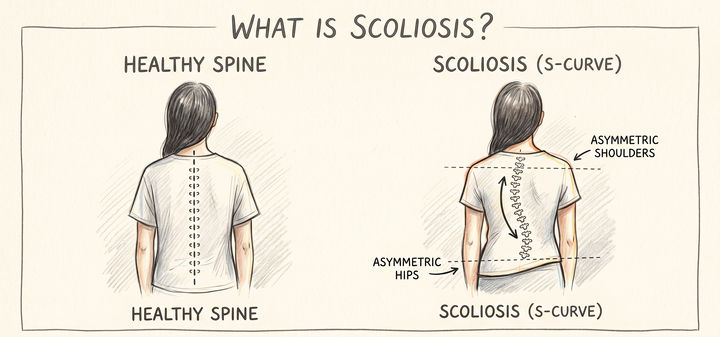
Scoliosis is a structural condition characterized by an abnormal, sideways curvature of the spine—often forming an "S" or "C" shape when viewed from behind. While a healthy spine has natural curves from front to back, it should appear straight from the rear. A curve is typically diagnosed as scoliosis if it measures greater than 10 degrees.
It is a progressive condition, meaning it can change over time, which is why early detection and proactive management are so critical to maintaining long-term quality of life and spinal health.
2. Common Symptoms

Scoliosis often develops gradually, meaning symptoms can be subtle at first. As the spinal curvature progresses, it can alter the body's symmetry and place uneven stress on surrounding muscles and joints.
Keep an eye out for these frequent signs:
-
Uneven Shoulders: One shoulder blade may appear higher or stick out more prominently than the other.
-
Asymmetrical Waistline: One hip might look higher, or the waist may appear uneven on one side.
-
Rib Hump: When bending forward, one side of the upper back or ribs may look noticeably higher.
-
Postural Lean: The entire body may tilt slightly to one side.
-
Chronic Muscular Discomfort: Persistent muscle fatigue, stiffness, or dull aches in the back due to muscles overcompensating for the spinal imbalance.
3. Common Causes

Understanding the root cause of scoliosis helps determine the most effective approach to care. Scoliosis generally falls into a few distinct categories based on its origin:
-
Idiopathic Scoliosis: This is the most common form, accounting for roughly 80% of cases. "Idiopathic" simply means the exact cause is unknown, though research strongly suggests a genetic component.
-
Congenital Scoliosis: This type is present at birth and occurs when the spinal vertebrae do not form properly during early fetal development.
-
Neuromuscular Scoliosis: Caused by underlying medical conditions that affect the muscles and nerves supporting the spine, such as cerebral palsy or muscular dystrophy.
-
Degenerative Scoliosis: This form develops later in adulthood, typically resulting from natural wear-and-tear, arthritis, or the degeneration of spinal discs over time.
4. Risk Factors

While anyone can develop scoliosis, certain factors increase the likelihood of its onset or progression:
-
Age: The most common form (idiopathic) typically develops during the growth spurt just before puberty, usually between the ages of 10 and 15.
-
Family History: Scoliosis can run in families. Having a parent or sibling with the condition elevates the risk.
-
Sex: While both boys and girls develop mild scoliosis at similar rates, girls have a significantly higher risk of the spinal curve progressing to a severity that requires treatment.
5. Treatment Options for Scoliosis

Managing scoliosis is about finding the right support for your spine at the right time. Because every curve is different, care options range from gentle, non-invasive therapies to structured structural support, depending on your age and how much the spine curves.
Our main goal is always to maximize your comfort and mobility using the most conservative methods possible.
-
Active Observation (For Mild Curves): If a spinal curve is under 20 degrees, we closely monitor it with regular posture checks and specialized imaging. This ensures that if the spine changes, we can step in early with proactive care.
-
Chiropractic Care & Mobility Support: For spines that are stiff or aching due to curvature, targeted chiropractic adjustments focus on restoring healthy movement to locked spinal joints. While it doesn't "straighten" a structural bone curve, it is highly effective at reducing joint stress, relieving chronic muscle tension, and improving day-to-day comfort.
-
Custom Corrective Bracing: Recommended primarily for growing children and teens with moderate curves (between 20 and 40 degrees). A custom-fitted brace acts as a gentle guide, holding the spine in place during growth spurts to prevent the curve from progressing.
-
Specific Strengthening Exercises: Customized physical therapy focuses on the muscles supporting your spine. By strengthening the weaker side of the back and core, we help your body better support its own alignment and combat muscle fatigue.
-
Surgical Options (As a Last Resort): Surgery (such as spinal fusion) is generally reserved only for severe cases (typically over 45 to 50 degrees) where the curve continues to worsen and begins to impact overall physical health or organ function.
6. How Chiropractic Assessment Works
Our goal is to understand the exact mechanics of your spine. A thorough scoliosis assessment at our clinic is a structured, detailed process:
1 Comprehensive History
Step 1
We discuss your lifestyle, daily activities, onset of symptoms, and any family history of spinal conditions to get a complete clinical picture.
2 Visual Postural Analysis
Step 2
We check for physical signs of asymmetry, including shoulder height, hip alignment, and perform the Adam’s Forward Bend Test to observe any rib cage elevation.
3 Orthopedic & Neurological Testing
Step 3
We assess your spinal range of motion, muscle balance, and nerve function to identify exactly where the body is overcompensating.
4 Imaging Review
Step 4
We analyze spinal imaging to precisely measure the Cobb angle (the degree of the spinal curve) to guide our care plan safely.
7. How Treatment May Help: The Chiropractic Adjustment
While chiropractic care does not "cure" structural scoliosis, it focuses on optimizing the function of the spine and improving the patient’s day-to-day comfort.
Restoring Motion and Reducing Stress
Gentle, targeted chiropractic adjustments help improve joint mobility in the regions of the spine that have become stiff or locked due to the curvature. By restoring movement to these restricted segments, we help redistribute mechanical stress more evenly across your skeleton.
Relieving Muscle and Nerve Tension
When the spine curves, the surrounding muscles on one side are forced to work overtime to keep the body upright, leading to painful spasms and tension. Adjustments help alleviate this chronic muscular strain and reduce localized nerve irritation, helping you move more freely and with less daily discomfort.
Meet Your Chiropractor
My name is Priscilla Lim
"Every spine tells a unique story. Our approach to scoliosis is centered entirely around the individual—focusing on gentle, non-invasive methods to restore balance, build structural strength, and help you live life with less restriction."
-
Certified in Webster Technique (ICPA)
-
Registered Healthcare Professional (KKM)
-
Experienced in Safe, Modification-Focused Maternity Care
-
Gonstead Technique Seminar 2022 by Dr. David Currie, DC
-
Gonstead Technique Seminar 2023 by The Gonstead Chiropractic Society (Australia)
-
Sacro-Occipital Technique (SOT) for Pediatric (ongoing training) by The Peak Potential Institute (USA)

Frequently Asked Questions
q Can a chiropractic adjustment straighten a scoliosis curve?
No, structural scoliosis involves a physical change in the shape of the bones. Chiropractic care cannot reverse or completely flatten a structural spinal curve, but it is highly effective at improving joint mobility, relieving muscular pain, and helping the body adapt comfortably.
q Is chiropractic care safe for children with scoliosis?
Yes, chiropractic care for children and adolescents utilizes specialized, incredibly gentle, low-force techniques tailored to a growing skeleton. We focus entirely on supporting spinal mobility and working alongside any bracing protocols your medical team recommends.
q How often will I need to come in for care?
Frequency depends entirely on your unique spine, age, and individual goals. After your initial assessment, we outline a clear, structured care plan tailored specifically to manage your symptoms and support your mobility—without unnecessary, open-ended timelines.
Address
22, Jalan Jaya Putra 7/2,
Bandar Jaya Putra, Johor Bahru