

1. What is Diastasis Recti?
Diastasis Recti Abdominis (DRA) is the partial or complete separation of the rectus abdominis muscles—commonly referred to as your "six-pack" muscles—meeting at the midline of your stomach.

Understanding Diastasis Recti
During pregnancy, the connective tissue called the linea alba thins and stretches out sideways to accommodate your growing baby. When these muscles separate too far, the core loses its structural stability, leaving you feeling unsupported.
2. Common Symptoms
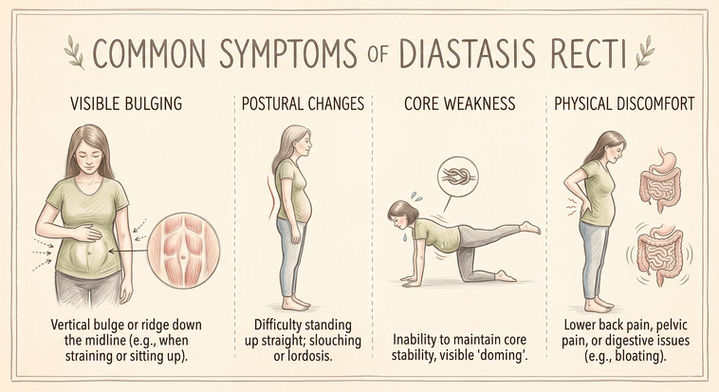
Many women don't realize that standard postpartum core weakness might actually be underlying muscle separation. Look out for these signs:
-
A visible "pouch", dome, or ridge running down the center of your stomach, especially when sitting up, coughing, or twisting.
-
Persistent lower back, pelvic, or hip pain due to a lack of core support.
-
Poor posture and feeling uncharacteristically weak in your torso.
-
Pelvic floor dysfunction, including stress urinary incontinence (leaking when coughing or sneezing).
-
Digestive issues like bloating, constipation, or a feeling of "emptiness" in your abdomen.
3. Risk Factors for Diastasis Recti

While roughly 60% of pregnant individuals experience some degree of separation by the third trimester, your risk increases if you meet any of the following criteria:
-
Multiple Pregnancies: Consecutive or closely spaced pregnancies do not allow the abdominal tissues sufficient recovery time between deliveries.
-
Maternal Age: Women who are pregnant over the age of 35 often have naturally less elastic connective tissue (the linea alba), making it harder for muscles to snap back.
-
Fetal Variables: Carrying twins or multiples, or carrying a single baby with a high birth weight (macrosomia), places a higher physical demand on the core.
-
Physical Stature: Petite women or those with a shorter torso often experience more profound mechanical stretching because there is less vertical space for the growing baby
4. Causes During Pregnancy

Diastasis recti isn't a sign of injury; it's a natural physiological adaptation gone slightly into overdrive. It is primarily driven by two synchronized factors:
-
Hormonal Changes: Your body releases high levels of relaxin and progesterone. These hormones naturally loosen your ligaments and connective tissues so your pelvis can expand for birth, but they also soften the abdominal midline.
-
Mechanical Pressure: As the fetus grows, the expanding uterus exerts continuous, outward hydrostatic pressure directly against the back of your abdominal wall.
5. Treatment Options for Diastasis Recti
Recovering from abdominal separation requires a multi-disciplinary, conservative approach. It is rarely solved by standard fitness routines alone.
-
Targeted Physical Therapy: Working with a pelvic floor or postpartum rehabilitation specialist to retrain the transversus abdominis (your deepest core layer).
-
Prenatal & Postpartum Chiropractic Care: Realigning the pelvic bowl and lumbar spine to reduce structural stress on the healing abdominal tissues.
-
Biomechanical Modifications: Learning safe everyday movement patterns, such as utilizing the "log roll" technique when getting out of bed to prevent intra-abdominal pressure spikes.
-
Surgical Intervention: Only considered as a last resort for severe, non-healing cases accompanied by umbilical hernias after exhaustive conservative therapy.
6. How Chiropractic Assessment Works
Before any treatment begins, a specialized prenatal chiropractic assessment evaluates how your spine, pelvis, and core function as a unified unit.
1 Static & Dynamic Palpation
Step 1.
We manually measure the width and depth of your separation using precise finger-width tracking at rest and under slight tension.
2 Pelvic Alignment Check
Step 2.
We check for pelvic imbalances or structural rotation. An asymmetric pelvis puts uneven mechanical tension on your left and right abdominal walls.
7. How Treatment May Help: The Chiropractic Adjustment
Many people wonder how a chiropractic adjustment affects an abdominal muscle issue. The secret lies in your skeletal framework.

When your spine and pelvis are misaligned, your posture shifts forward, worsening the pelvic tilt. This posture stretches the front of your abdomen even further, preventing the separated muscles from knitting back together.
By applying gentle, low-force prenatal adjustments (often utilizing the specialized Webster Technique), we balance your pelvis and take unnecessary, mechanical stress off your healing abdominal wall.
Meet Your Prenatal Chiropractor
My name is Priscilla Lim
"My mission is to empower mothers to move comfortably and confidently through pregnancy and beyond. Motherhood shouldn't mean living with chronic pain or core weakness."
-
Certified in Webster Technique (ICPA)
-
Registered Healthcare Professional (KKM)
-
Experienced in Safe, Modification-Focused Maternity Care

Frequently Asked Questions
q Can I fix Diastasis Recti while I am still pregnant?
You cannot completely close the gap while your baby is growing inside, but prenatal care aims to prevent the separation from getting worse, manage your pain symptoms, and prime your body for a faster postpartum recovery.
q Are traditional crunches and sit-ups good for treating this condition?
No! Traditional crunches and sit-ups cause your abdominal wall to dome outward, increasing intra-abdominal pressure and actually widening the gap. We will teach you which specific movements to avoid.
q Is the chiropractic adjustment safe during pregnancy?
Absolutely. Prenatal chiropractic care utilizes specialized tables, pregnancy pillows, and gentle, non-rotational techniques designed specifically for a mother’s changing body and safety.
Address
22, Jalan Jaya Putra 7/2,
Bandar Jaya Putra